| Radiation therapy for cats and dogs with cancer |
| What is radiation therapy? Radiation therapy is a type of treatment that uses penetrating beams of high energy waves (gamma rays) or streams of particles (generated by linear accelerators) that kill cancer cells by damaging their DNA. Intact DNA is necessary in order for the cancer cell to continue dividing, therefore, radiation-induced DNA damage will either eventually kill the cancer cell or will stop it from multiplying. The treatment is not used to irradiate the whole body but rather focus it on the area where the tumor is located. Fast facts about radiation therapy for cats and dogs with cancer
How do I find a facility that offers radiation therapy for cats and dogs? To locate a facility that offers radiation therapy for pets, please click on the following links: Radiation oncology facilities for cats and dogs with cancer in the U.S., Australia, Canada and Europe (from Veterinary Cancer Society) What are the advantages of using linear accelerators as radiation therapy for cats and dogs? New linear accelerators have both photon and electron capability that allows radiation oncologists to treat deep-seated tumors (such as brain tumors or medial iliac lymph nodes) with deeply penetrating 6 MV photons, and most skin or subcutaneous tumors with more superficially penetrating electron beams. Electron-beam radiation allows delivery of a high dose of radiation to a superficial tumor site, but the radiation does not penetrate very far into tissue. This is critically important for body-wall tumors (such as mast cell tumors or sarcomas) that overlie the thorax (chest), abdomen, or cranium to allow effective sparing of deeper normal tissues such as lungs, heart, kidneys, spinal cord, and brain. The linear accelerators also come with a 120-leaf, multi-leaf collimator which, when combined with three-dimensional computerized treatment-planning system, which will allow conformal shaping of the radiation beam to block critical structures located near the tumor bed. This is particularly important, for example, to spare the eye and brain when treating nasal or skull tumors, the heart when treating tumors located within the thorax or abdomen, and tumors near the spinal cord (this section was contributed by Dr. Christine Anderson from Angell Animal Medical Center, Boston, MA) How does radiation therapy work? Radiation in high doses will kill cells or prevent them from muliplying by damaging their DNA. Cancer cells have been shown to divide (multiply) more rapidly compared to normal cells, therefore, radiation therapy will preferentially target these cancer cells. Unfortunately, radiation will also damage some normal cells, but normal cells are usually capable of repairing themselves and recovering from the effects of radiation. With the advancements of new imaging techniques such as computed tomography (CT), magnetic resonance imaging (MRI), and nuclear scanning, veterinary oncologists are usually able to shield as much normal tissue as possible while focusing the radiation beam to the target area where the tumor is located. Factors to consider before radiation therapy for your pet
How much does radiation therapy cost for cats and dogs? The cost of radiation therapy for cats and dogs will differ for each center and will depend on whether the intent of radiation therapy is to treat the tumor before surgery, after surgery or to only provide the pet with some pain relief from the tumor. Below are the cost estimates provided by North Carolina State University College of Veterinary Medicine:
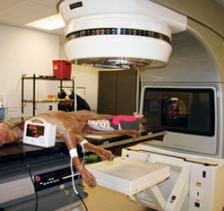
When is radiation therapy used in cats and dogs with cancer? Radiation therapy can be used on a variety of different cancers and is often used in combination with surgery and/or chemotherapy. Radiation can be used prior to surgery to shrink the tumor to a smaller size or it can also be used after surgery to stop the growth of any cancer cells that may have been left behind. Sometimes, radiation therapy is administered during the surgery, a process called intraoperative radiation. Radiation therapy is also used on tumors that cannot be removed with a surgery. Radiation can be also used in combination with chemotherapy without surgery. It can be administered before, during or after chemotherapy treatment, depending on the type of cancer, its location and size. When irradiating tumor before chemotherapy, it shrinks its size and thus enables chemotherapy to become more effective on the remaining cells. Sometimes the opposite is done - the chemotherapy treatment will be used to shrink the tumor, followed by radiation to kill any remaining cells. When cure is not an attainable goal, radiation can be used to shrink the tumor size to alleviate the pressure of the tumor on neighboring tissues or organs, to lessen cancer-related pain or other symptoms. When any treatment is used to alleviate rather than cure cancer, the process is referred to as palliative care (or palliation). While radiation won't be able to rid the body of cancer, it can substantially enhance the pet's quality of life. How often is radiation therapy administered for cats and dogs with cancer? When radiation therapy is used to try to cure the pet of cancer, it is given in small fractions over 2-5 weeks, depending on the type, size and location of the cancer and pet's health. When radiation therapy is used for palliative reasons (to alleviate symptoms without cure), it is given in large fractions, usually once for three weeks. What are the risks of radiation therapy for cats and dogs with cancer? The high doses used to irradiate tumor can also damage or kill normal cells, leading to side effects. Fortunately, many adverse reactions associated with irradiation are well known and can be treated. Acute side effects usually occur during or shortly after radiation therapy, and involve tissues with rapidly dividing cells (such as in head and neck region, intestines, eyes, and skin). Some pets may experience redness and irritation at the area of irradiation and the injuries will resemble that of a sunburn. The area may be very itchy for the pet in which case anti- itching medication is given to prevent the pet from further aggravating the skin damage. The pet may experience hair loss at the area of radiation, but the hair will grow back, although the color may change (as shown in the below figure). If radiation is administered to the head and neck region, the pet may become reluctant to eat or drink in which case either hand feeding of special diet or placement of a feeding tube along with subcutaneous administration of fluids may be necessary to prevent dehydration and malnourishment. The pets may experience neurological signs if brain was irradiated. When the radiation is targeting an area close to the eye, the pet may experience changes in vision and/or loss of tears. There is always some risk associated with general anesthesia during the irradiation but the pets will be monitored throughout the procedure and the duration is usually short. While the acute side effects may be unpleasant, the pets usually recover with proper treatment within a few weeks. Late effects of radiation typically occur 6-12 months after radiation therapy and involve tissues with slowly dividing cells (such as bone, lung, heart, kidneys, and spinal cord). Late complications include cataract formation, blindness, bone necrosis and, in the case of the spinal cord, paralysis. When they do occur, they may be more serious and can result in more severe side effects, and sometimes even death. The symptoms of late reactions should be treated by a doctor experienced in radiation injury and great care is taken in treatment planning to keep the risk of late complications extremely low. Treatment of radiation therapy side effects As previously mentioned, painful acute side effects of radiation therapy can include inflammation in the mouth, skin, eyes or intestine, which are typically seen more often with full-course radiation therapy. It is very important to prevent any additional damage to the area caused by the pet's pawing or licking so Elizabethan collars should be used as needed. Inflammation in the mouth can be treated with oral rinse solutions (e.g. a weak tea solution, chlorhexidine rinse, or mixture of viscous lidocaine, liquid diphenhydramine, and magnesium hydroxide). Types of radiation therapy used in cats and dogs with cancer External-beam radiation The radiation used in cancer treatment is either in the form of gamma rays (emitted from a material called cobalt-60) or in the form of charged particles such as electrons (generated by linear accelerators). The pet will be placed on a table under the source of radiation (as shown in the first figure above) and as soon as the treatment is over, the pet won't be radioactive. The radiation therapy is typically given in fractions rather than all at once, requiring either daily or several times a week visits to the hospital. Brachytherapy Another method of administrating radiation therapy is to deliver radiation directly to the tumor. This method is also known as implant therapy or internal radiotherapy. In this method, the veterinarian will place radioactive implants directly into a tumor or the location where the tumor was so that the radiation dose is concentrated in the small target area. Depending on the tumor, it can be done either with a large needle or through minor surgery. The pet will remain radioactive until the implants are removed and the pet will be required to stay in the hospital for about a week to prevent radiation exposure to others. It has been used for dogs with nasal tumors and fibrosarcomas in cats. Intraoperative radiation This type of radiation therapy refers to a method which delivers large dose of radiation to a tumor and its surrounding tissues during a surgery. Systemic radiotherapy In this method, a radioactive isotope is given orally or by injection to travel through the body to find a target tissue to irradiate. It has worked well with older cats for treatment of hyperthyroidism. Typically, the cat will be kept in isolation until most of the radioactivity has been eliminated from its body to minimize others' risk of exposure. Radioactive iodine therapy for thyroid cancer in cats and dogs Iodine is normally taken up by the thyroid gland. One form of iodine, I-131, is radioactive and when it enters the thyroid gland, it destroys the cancer cells. This reduces the size of the thyroid gland and reduces the amount of thyroid hormone. Cats treated with I-131 need to be hospitalized for 4-7 days following the injection to avoid exposing others to radioactivity. When the level of radioactivity reaches a safe level, the pets can go home. Cases when radiation therapy won't be effective in cats and dogs with cancer Pet owners should keep in mind that radiation therapy may not be the appropriate treatment for some cases. Some tumors are known to be resistant to radiation and some tumors are located in an area in which the normal cells present also happen to be very sensitive to radiation (such as cells in the gastrointestinal tract). In this case, the radiation would kill not only the tumor cells but also the normal cells, leading to devastating consequences for the pet. Which tumors are commonly treated with radiation?
Additional online resources:
Sources:
|
Linear accelerator used for radiation therapy in dogs.
Source: www.veterinarypracticenews.com/images/article-images/Surgery.jpg
Source: www.veterinarypracticenews.com/images/article-images/Surgery.jpg

A change in hair color after radiation therapy.
Source: www.cvm.tamu.edu/oncology/faq/questions/side01.html
Source: www.cvm.tamu.edu/oncology/faq/questions/side01.html


| PET CANCER CENTER Comprehensive guide to cancer diagnosis and treatment in cats and dogs |

Radiation Therapy
© 2007 Pet Cancer Center. ALL RIGHTS RESERVED.
Last updated 2/20/2017